Forex Signals for Technical Traders

Forex signals for technical traders provide real-time trading opportunities based on chart analysis, price patterns, and technical indicators. These signals help traders identify potential entry and exit points in the Forex market without constantly monitoring charts. By using tools such as moving averages, RSI, MACD, and support and resistance levels, technical forex signals aim to highlight high-probability trading setups. Whether generated manually by analysts or automatically by trading algorithms, forex signals can help traders improve decision-making, manage risk, and execute trades more efficiently.
| Feature | Description |
| Definition | Trade recommendations based on technical market analysis |
| Main Purpose | Identify potential buy or sell opportunities in the Forex market |
| Key Components | Entry price, stop loss, take profit, and trade direction |
| Analysis Method | Technical indicators, chart patterns, and price action |
| Common Indicators | Moving averages, RSI, MACD, Bollinger Bands |
| Signal Types | Manual signals, automated signals, and algorithmic signals |
| Timeframes | Scalping, intraday, and swing trading signals |
| Main Benefit | Helps traders identify trading setups quickly and efficiently |
10 Best Forex Brokers – Globally
What Are Forex Signals?
Forex signals are trade recommendations that tell traders when to buy or sell a currency pair based on market analysis. They typically include specific trading parameters such as entry price, stop-loss, and take-profit levels.
A typical forex signal contains:
| Component | Meaning |
| Currency Pair | The instrument being traded (e.g., EUR/USD) |
| Direction | Buy or Sell |
| Entry Price | Recommended price to open the trade |
| Stop Loss (SL) | Risk control level if the trade goes wrong |
| Take Profit (TP) | Target level for closing the trade |
| Timeframe | Duration of the trade (M15, H1, H4, etc.) |
These signals help traders quickly identify trading opportunities without having to analyze the entire market themselves.

 | Minimum Deposit: $100 Regulated by: CBI, BVI, FSC, ASIC, FSCA, JFSA, FFAJ Crypto: Yes |
How Forex Signals Work
Forex signals work by identifying trading setups based on predefined market conditions. When those conditions occur, the signal is generated and shared with traders.
The process generally follows three steps:
1. Market Analysis
Indicators and price action are analyzed. Support and resistance levels are identified.
2. Signal Generation
A trading setup is created with entry, stop loss, and targets.
3. Signal Distribution
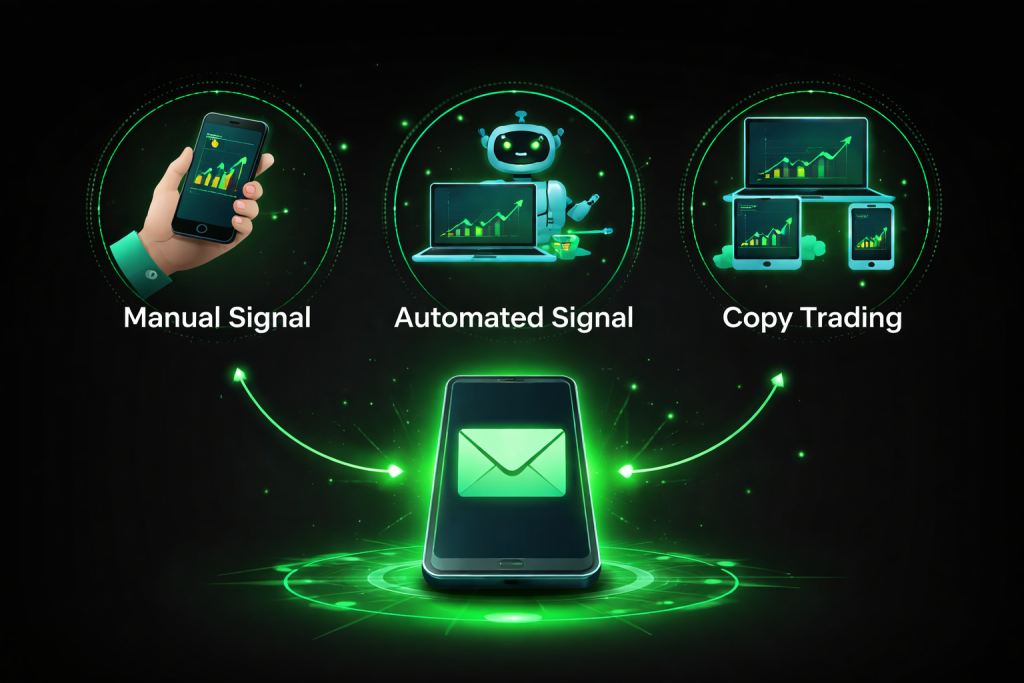
Signals are delivered via trading platforms, mobile apps, email alerts, or messaging channels.
Traders can then manually place the trade or automate it using trading software.

 | Minimum Deposit: $50 Regulated by: AUSTRAC, BAFIN, CIMA, ESCA, CySEC, FSC, FMA, MAS, TFG, VFSC Crypto: Yes |
Types of Forex Signals
Forex signals can be categorized based on how they are generated.
1. Technical Signals
These signals rely on historical price data and chart analysis to identify potential trading opportunities. Traders often use tools such as:
- Moving averages
- RSI (Relative Strength Index)
- MACD
- Trendlines
- Support and resistance levels
- Chart patterns
These tools help identify potential trend continuation or reversal points in the market.
Example signal:
- Buy EUR/USD at 1.0850
- Stop Loss: 1.0820
- Take Profit: 1.0900
2. Fundamental Signals
These signals are generated from economic events and macroeconomic data. Examples include:
- Interest rate decisions
- Inflation reports
- Employment data
- Central bank announcements
Fundamental signals often explain why a currency may strengthen or weaken.
3. Automated Signals
Automated signals are generated by algorithms or trading robots that continuously scan the market. These systems:
- Monitor multiple indicators simultaneously
- Detect patterns automatically
- Send signals in real time
Automated signal systems rely heavily on technical indicators and mathematical models to identify trading opportunities.
 | Minimum Deposit: $25 Regulated by: FSC, MISA Crypto: Yes |
Common Technical Indicators Used for Forex Signals
Technical signal providers often rely on a combination of indicators to generate reliable trade ideas.
Trend Indicators
- Moving Averages
- Ichimoku Cloud
Momentum Indicators
- RSI
- Stochastic Oscillator
- MACD
Volatility Indicators
- Bollinger Bands
- Average True Range (ATR)
Reversal Indicators
- Fibonacci Retracements
- Parabolic SAR
These indicators help traders identify trend direction, momentum strength, and potential reversal zones.

 | Minimum Deposit: $10 Regulated by: ASIC, BaFin, CMA, CySEC, DFSA, FCA, SCB 73-89 % of retail investor accounts lose money when trading CFDs Crypto Yes (only CFDs) |
Timeframes of Forex Signals
Signals can vary depending on the trader’s strategy.
| Signal Type | Typical Duration | Pip Target |
| Scalping Signals | Minutes | 5–20 pips |
| Intraday Signals | 1–6 hours | 20–60 pips |
| Swing Signals | 1–5 days | 70–250+ pips |
Short-term signals are commonly used by day traders, while longer signals are used by swing traders and position traders.

 | Minimum Deposit: $50 Regulated by: CySEC, ASIC, FSA, SVG, FSCA Crypto: Yes |
Benefits of Forex Signals for Technical Traders
Faster Decision-Making
Signals highlight potential opportunities quickly, reducing analysis time.
Structured Trading
Signals include predefined entry, stop loss, and take profit levels.
Learning Tool
Traders can study signals to understand how technical setups are identified.
Multi-Market Monitoring
Signal systems often monitor dozens of currency pairs simultaneously.

 | Minimum Deposit: $5 Regulated by: FSC Crypto: Yes (not available under CySEC (EU) or DFSA (MENA). |
Risks and Limitations of Forex Signals
Despite their usefulness, signals are not guaranteed to produce profits.
Over-Reliance
Traders who depend entirely on signals may fail to develop their own analysis skills.
Timing Issues
Signals may become outdated if traders enter the trade too late.
Scam Signal Providers
Some providers promise unrealistic win rates or guaranteed profits.
A reliable signal service should provide:
- Transparent track record
- Clear risk management
- Realistic performance expectations
Forex signals can be helpful tools, but they should never replace your own understanding of the market. The most successful traders use signals as guidance alongside their own analysis and risk management, rather than relying on them blindly.

 | Minimum Deposit: $0 Regulated by: FSCA, FSA, FCA, FSC, CMA Crypto: Yes |
How Technical Traders Use Forex Signals
Technical traders typically use signals in three ways:
Confirmation Tool
Signals confirm a trade idea already identified on the chart.
Trade Filtering
Signals help traders avoid low-probability setups.
Automated Execution
Signals can be linked to trading bots that execute trades automatically.

 | Minimum Deposit: 20 USD (Cent) Regulated by: FSA, FSC, FSCA, CMA, ASIC Crypto: Yes |
In Conclusion
Forex signals provide structured trading opportunities derived from technical or fundamental analysis. For technical traders, signals serve as a powerful tool to identify potential market setups, streamline analysis, and maintain disciplined risk management.
However, signals should be used as a supplement to independent analysis rather than a replacement for trading knowledge. Successful traders combine signals with technical indicators, market context, and sound risk management to make informed trading decisions.
You might also like:
- AvaTrade Review
- MultiBank Group Review
- Elev8 Review
- Pepperstone Review
- FISG Review
- XM Review
- HFM Review
- PU Prime Review
Frequently Asked Questions
What are forex signals?
Forex signals are trade recommendations that suggest when to buy or sell a currency pair. They usually include an entry price, stop loss, take profit level, and trade direction based on market analysis.
How do technical traders use forex signals?
Technical traders use signals to confirm chart setups, filter potential trades, or execute positions faster. Signals can complement technical analysis by highlighting opportunities that match predefined indicator conditions.
What information does a typical forex signal include?
A typical forex signal includes the currency pair, buy or sell direction, entry price, stop-loss level, take-profit target, and timeframe. These elements help traders understand the structure and risk of the trade.
Are forex signals suitable for beginners?
Yes. Forex signals can help beginners identify potential trading setups without needing advanced analysis skills. However, beginners should still learn technical analysis and risk management rather than relying entirely on signals.
What indicators are commonly used in technical forex signals?
Common indicators include moving averages, RSI (Relative Strength Index), MACD, Bollinger Bands, and support and resistance levels. These tools help identify trends, momentum, and possible reversal points.
 ABOUT THE AUTHOR
See More
ABOUT THE AUTHOR
See More


Sidebar rates

